
Erection and Installation
Main Frame Erection:

Erection should ideally begin with the installation of braced bays, as they provide essential support for other structural members during the erection process. Regardless of the installation method chosen by the erectors, it is crucial to incorporate proper erection bracing, which may need to be more robust than the permanent bracing of the building.
According to MBMA Common Industry Practices, the bracing supplied by the manufacturer for the metal building system should not be assumed to be sufficient during erection. Inadequate bracing has led to the collapse of metal buildings during the erection process, emphasizing the importance of proper temporary bracing for safety and stability.
Installation of Girts and Purlins:
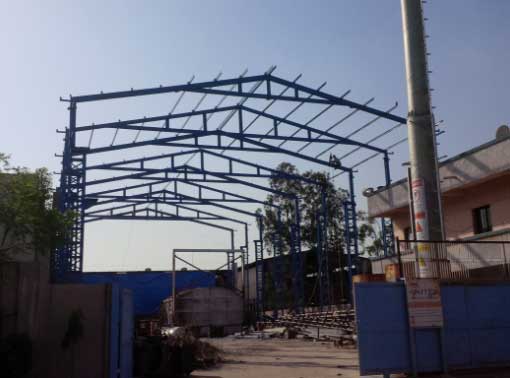
Some girts and purlins necessary for bracing are installed along with the main frames, and the remainder is put in place immediately thereafter. Girts and purlins may be bolted directly to the main framing steel or be attached to it via bearing clips pre-welded to the frame, (as supplied by Velar Structures).
It is often more cost-effective to raise the purlins onto the roof in bundles rather than one by one. The bundles are placed near the eaves, from where the erectors can move the individual purlins to their intended positions by hand. Purlin bracing should be set in place as soon as possible, and definitely before the roofing is installed.
Placement of Insulation:

Insulation is installed after the secondary steel framework is in place but before the cladding is applied. In buildings with fiberglass insulation under through-fastened roofing, the roofing is secured directly to the purlins, passing through the insulation layer.
VELAR STRUCTURES recommends allowing the roof insulation to overhang the framing edge. To prevent moisture wicking, approximately 150 mm of fiberglass should be removed from the facing, and the facing should be folded back over the insulation.
The installation of roof blanket insulation is a high-risk task, as the roofing is not yet in place to support workers in the event of a fall. Therefore, proper safety measures must be implemented to ensure worker protection during the process.
Installation of Roof and Wall Panels:

Whether roof or wall panels are installed first is a matter of the erector’s preference. We slightly favor erecting the roof first to allow for any interior finish work to begin and to improve the roof diaphragm action in the partially constructed building.
Installation of roof panels usually starts at one of the end walls chosen to allow for panel placement in the direction opposite to the prevailing winds; this sequence is intended to decrease the chances of wind-blown water intrusion into the panel side-laps.
Stepping on the panel ribs is strongly discouraged by manufacturers, as is walking on partially attached or unattached panels. The safe way to walk on a fully fastened roof is to step on walk boards laid in the panels’ flat areas and spanning between the purlins.
To prevent slippage, the walk boards should be secured to the roofing. If stepping on the panels is unavoidable, one should attempt to walk directly above the purlins where possible and stay away from the middle of the flat panel part. Wall panels are installed similarly to roofing.

